
When Malware Starts to Think: Why AI-Driven Worms Require a New Security Layer
When Malware Starts to Think: Why AI-Driven Worms Require a New Security Layer
For decades, malware was primarily a problem of code, signatures, and known vulnerabilities. A traditional computer worm followed a fixed logic: it scanned for specific systems, exploited a predefined vulnerability, copied itself to the next machine, and repeated the process. This was dangerous, but still relatively predictable. Once defenders understood the vulnerability being exploited, they could patch it, block it, or detect it through signatures and behavioral rules.
That model is now beginning to break.
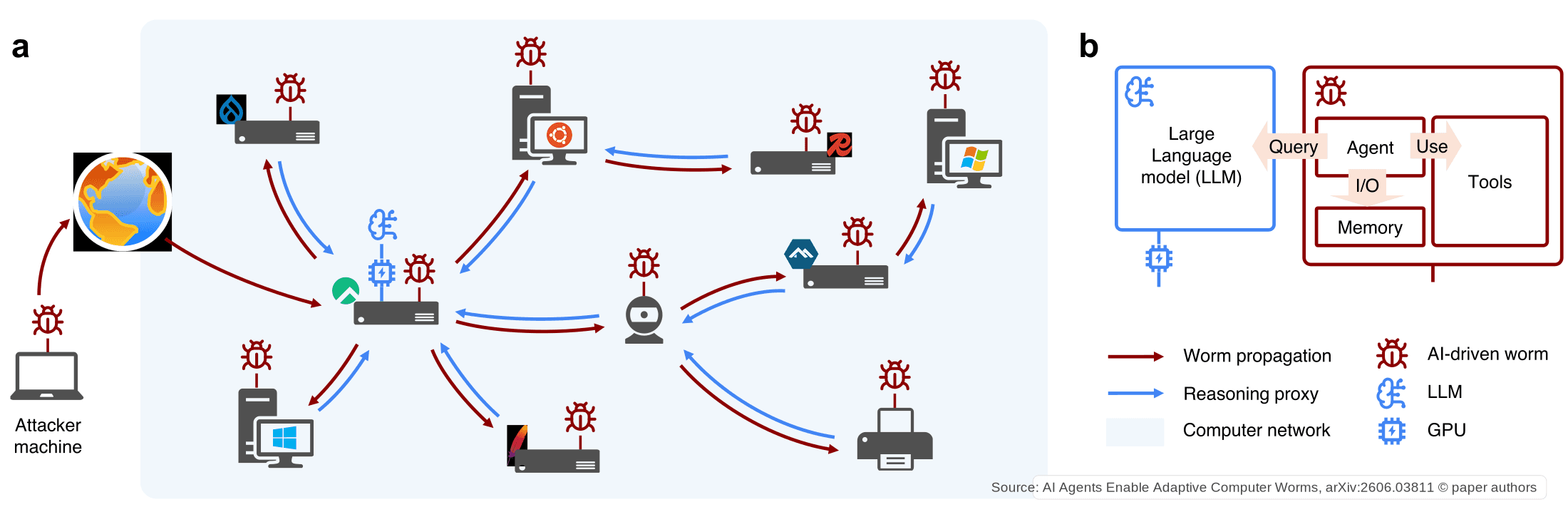
A recent research paper titled “AI Agents Enable Adaptive Computer Worms” demonstrates a new class of malware: an AI-driven adaptive computer worm. The key insight is not simply that AI can help attackers write malware. That would be too shallow. The real shift is deeper: the worm no longer needs a fully hardcoded attack chain. Instead, it uses an agentic AI system to observe targets, interpret information, plan suitable attacks, learn from failed attempts, and adapt its strategy at runtime.
In other words, the attack logic is no longer only written by the malware author. It is generated dynamically while the worm is operating.
This fundamentally changes how defenders need to think about malware. Traditional worms had their offensive capability baked into the binary. An AI-driven worm derives much of its capability from the combination of a model, memory, tools, and live runtime context. It does not just blindly scan for one known vulnerability. It can inspect which services are running, identify suspicious configurations, reason about reused credentials, decide which exploit path may fit a specific host, and choose an alternative when the first attempt fails.
This moves malware closer to the behavior of an autonomous penetration tester, but with the scale and propagation dynamics of a worm.
One of the most important aspects of the paper is that the worm is not dependent on commercial AI APIs. It can use open-weight models running on compromised infrastructure. That makes many centralized safety controls less effective. Rate limits, API account bans, provider-side refusals, and centralized AI logging are of limited value if the reasoning happens on an internal GPU host that has already been compromised.
The worm can compromise ordinary low-compute machines to expand its reach, while using powerful GPU machines as reasoning nodes. These GPU hosts can run local LLM inference and provide intelligence to other infected machines. A weak endpoint may not be able to run a large model itself, but it can still act as part of the swarm by querying an upstream reasoning node.
That is where the danger becomes asymmetric. The attacker does not need to pay for every additional reasoning step through a cloud API. Once the worm gains access to compute inside a target environment, it can parasitically use that infrastructure. Every new machine either increases reach or provides additional compute. This lowers the marginal cost of attacks and blurs the line between mass-scale malware and targeted intrusion.
Cybersecurity has historically relied on a distinction between scalable but unsophisticated attacks and sophisticated but expensive human-led operations. AI-driven worms threaten that distinction. They combine the reach of automated malware with the adaptability of an operator.
The paper is also important because it shows that frontier models are not the only concern. Smaller open-weight models can become dangerous when embedded inside a well-designed agent framework. The model alone is not the entire story. The real capability comes from the system around it: an agent core that plans and evaluates, a memory module that stores observations and hypotheses, and a tool layer that can execute shell commands, transfer files, deploy payloads, and interact with compromised hosts.
Modern malware is therefore starting to look less like a single binary and more like an autonomous operating system for attacks.
For defenders, this changes the detection problem. It is no longer enough to look only for known malware files, suspicious hashes, or fixed exploit signatures. It is also not enough to monitor prompts going into commercial AI applications. The dangerous unit is the chain: AI reasoning, tool execution, system modification, network movement, credential use, and replication.
Modern malware will not only be visible through what it is. It will be visible through what it does, and through the intent that can be inferred from a sequence of actions.
This is exactly where Patronus Protect comes in.
Patronus was not created because AI security is a fashionable category. It was created because we saw a structural gap emerging. Almost a year ago, we started asking what would happen once malware no longer followed a fixed script, but began using AI to reason, adapt, and make decisions at runtime.
The answer was uncomfortable: many existing approaches would become blind.
If an attack goes through a known SaaS AI provider, organizations may have some visibility through API logs, vendor controls, or cloud-based governance tools. But AI-driven malware has no reason to make detection easy. It can use local LLM servers, loopback traffic, open-weight models, compromised internal compute, developer tools, automation frameworks, or internal OpenAI-compatible endpoints. In that world, the most important AI activity may never touch an official cloud AI provider.
That is why Patronus intentionally takes the harder path.
We do not assume that AI usage only happens in approved applications. We do not assume that AI traffic only goes through known providers. And we do not assume that future AI threats will identify themselves as AI threats. Patronus is built to classify AI interactions directly where they happen: on the endpoint, in network traffic, and in loopback traffic.
This matters because AI-driven malware will try to minimize its footprint. It may avoid shipping large models with every infected host. It may instead use existing local model servers, compromised GPU machines, internal inference endpoints, or lightweight agents that query an upstream reasoning node. From the outside, this may look like normal local traffic, developer tooling, automation, or internal API usage. But semantically, the system may be using AI to plan reconnaissance, select tools, interpret results, and decide how to spread further.
The detection problem therefore changes. The question is no longer only whether a file is known to be malicious. The question becomes whether a system is using AI to plan behavior, execute tools, or adapt its next steps.
That is the layer Patronus is built for.
Patronus connects AI intent with runtime behavior. It is designed to detect and classify AI interactions even when they happen outside official AI platforms, and to correlate them with tool usage, network behavior, local model activity, and agentic workflows. This is what makes it relevant not only for today’s AI governance problems, but for a future where AI itself becomes part of the attack chain.