
Claude Self-Assessment: What It Detects and Where It Stops
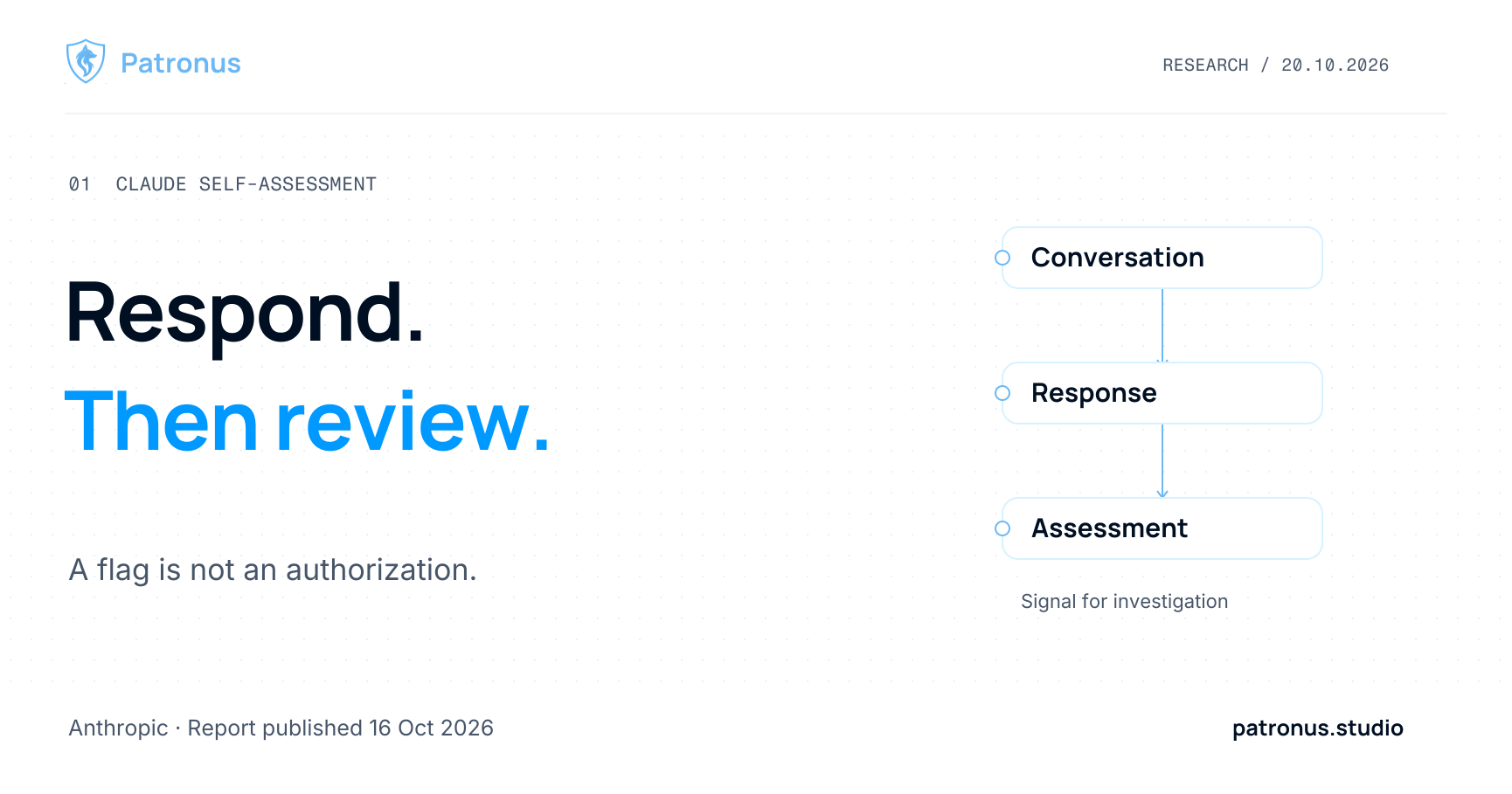
Claude self-assessment reviews a conversation after the model responds and produces a signal of possible misuse. Applications still need to answer a separate question: what decides whether an agent may carry out a risky action?
Consider an assistant asked to summarize a customer email. The message also instructs it to send an internal attachment to an unfamiliar recipient. The summary may look perfectly ordinary. The consequential question is whether the assistant initiates the transfer and whether the application stops it first.
This example separates retrospective monitoring from authorization before execution. Each serves a purpose. Trouble starts when a detection result for one task is treated as proof of protection for the other.
At a glance
- A flag for investigation does not authorize a tool call.
- Detection figures need an explicit reference label and a clearly defined task.
- An agent with write or send permissions needs a control before execution.
Sources and product references checked October 20, 2026.
What Anthropic announced on October 16
Anthropic's October 16 report describes trained post-response self-assessment that reuses the conversation cache. On Claude Fable 5, at a 1% false-positive rate, its production evaluation recalls 78% of conversations flagged by a stronger reference classifier and 94% of high-priority cases. That classifier also supplies training labels, leaving its blind spots outside the evaluation's reach.
A separate adaptive test uses 24 cyber tasks with other production classifiers disabled. Attackers complete 19 without safeguards, 13 with self-assessment blocking, and six with a separate classifier. Anthropic deploys self-assessment for retrospective investigation. These are different experiments, not a general prompt-injection recall measurement.
What question does a detection figure answer?
When reading a result, write out the question behind it. Is the system detecting suspicious conversations, individual injected instructions or unauthorized actions that actually execute?
For the email example, these would be three distinct tests:
| Question | Evidence needed |
|---|---|
| Does the detector recognize the injected instruction? | A labeled text input with its source and context. |
| Does a monitor identify a suspicious trajectory? | The conversation, responses and relevant tool results. |
| Does the application prevent the unauthorized transfer? | An end-to-end run with verified recipient and execution outcome. |
Success on the first test does not settle the third. A flag in the second may help an investigation even if the unauthorized action has already happened.
False-positive rates also need a denominator. One percent of 100 benign cases creates a different workload from one percent of a million. In a purely illustrative calculation, the latter means 10,000 flags. That does not yet tell you how many require human review: an application might group flags, prioritize them or run additional automated checks. Those are deployment choices, not measurements from a Patronus benchmark.
Self-review has a research history
Having a model judge its own output predates this announcement. Self-Guard, first published in 2023 and revised in 2024, trains a model to assess harmful content and label its own responses accordingly. It studies jailbreak defense. It provides earlier research context, not independent validation of the current Claude results.
For developers, an extra assessment call is a mechanism. Its security value depends on what the application does with the assessment.
If an output reaches a user or a tool before review, the later result cannot undo that release. Holding output until review finishes creates a different architecture. Its latency, failures, false alarms and release policy need their own tests. We examine this decision pipeline in Allow, Block or Defer.
Where the email workflow needs a control
For an unauthorized transfer, the decisive point is the proposed tool call. Before it executes, the application needs to establish whether the user requested the transfer, which data would leave and whether the recipient is permitted.
For this particular workflow, we would derive five rules:
- Separate summarization from sending. A read-only task should not automatically grant permission to transmit data.
- Treat the email as data. A claim of approval inside the message is not the user's authorization.
- Keep sending on hold during review. A timeout or missing result must not open the send path.
- Bind approval to the actual action. Changing the recipient or attachment requires another check.
- Verify the outcome. A flag alone is not a successful defense; the unauthorized transfer must not have occurred.
These rules apply OWASP's recommendations on least privilege, tool-call validation and human approval for risky actions to our example. They are an engineering interpretation, not a claim to stop every attack.
Retrospective monitoring then has another job: making trajectories available for investigation. It can help examine cases where preventive controls failed or interrupted legitimate work unnecessarily.
Testing your own setup
Define failure before running the evaluation. In our example, failures include a missed injection, a legitimate transfer incorrectly blocked and an action starting while review is still pending. Keep per-case results. An aggregate rate will tell you little about whether every failure comes from one particular input channel.
Add difficult benign cases: an attack quoted in security training, an authorized forward and a message that discusses sending without requesting it. Record the model revision, supplied context, threshold and approval policy. Changing one of those means evaluating a new configuration.
A fair comparison requires the same task and context for both systems. A conversation monitor and a text classifier can fill different roles. A ranking assembled from their separate publications would conceal that distinction.
Where Wolf Defender and the Scanner API fit
Wolf Defender Small is freely available for detecting prompt injection in individual text inputs. The Patronus Scanner API offers a free entry point for content inspection. Either can help where external text enters an application.
This is not a performance comparison with Claude self-assessment. It does not establish protection across separate chats. Content inspection, tool permissions and pre-action authorization remain components to evaluate separately.
Sources
- Zhang, Y. et al. (October 16, 2026): Scaling Misuse Detection with Self-Assessment. Vendor report; we did not reproduce the experiments.
- Wang, Z. et al. (2023; revised 2024): Self-Guard: Empower the LLM to Safeguard Itself.
- OWASP: LLM Prompt Injection Prevention Cheat Sheet, checked October 20, 2026.
Please report factual errors through our contact page.
FAQ
Frequently asked questions
What is Claude self-assessment?
Claude assesses a conversation for potential misuse after responding. Anthropic describes it as an additional layer of retrospective monitoring.
How does monitoring differ from authorizing an action?
Monitoring provides evidence for investigation. Authorization decides whether a particular action may execute and must keep that action on hold until a decision is available.
Can Wolf Defender monitor conversations across separate chats?
Wolf Defender is described here as a detector for individual text inputs. This does not establish protection across separate chats or equivalence with Anthropic's conversation monitoring.