
Introducing Tiger Guard: Content Moderation for Prompts, Responses and Comments on Your CPU
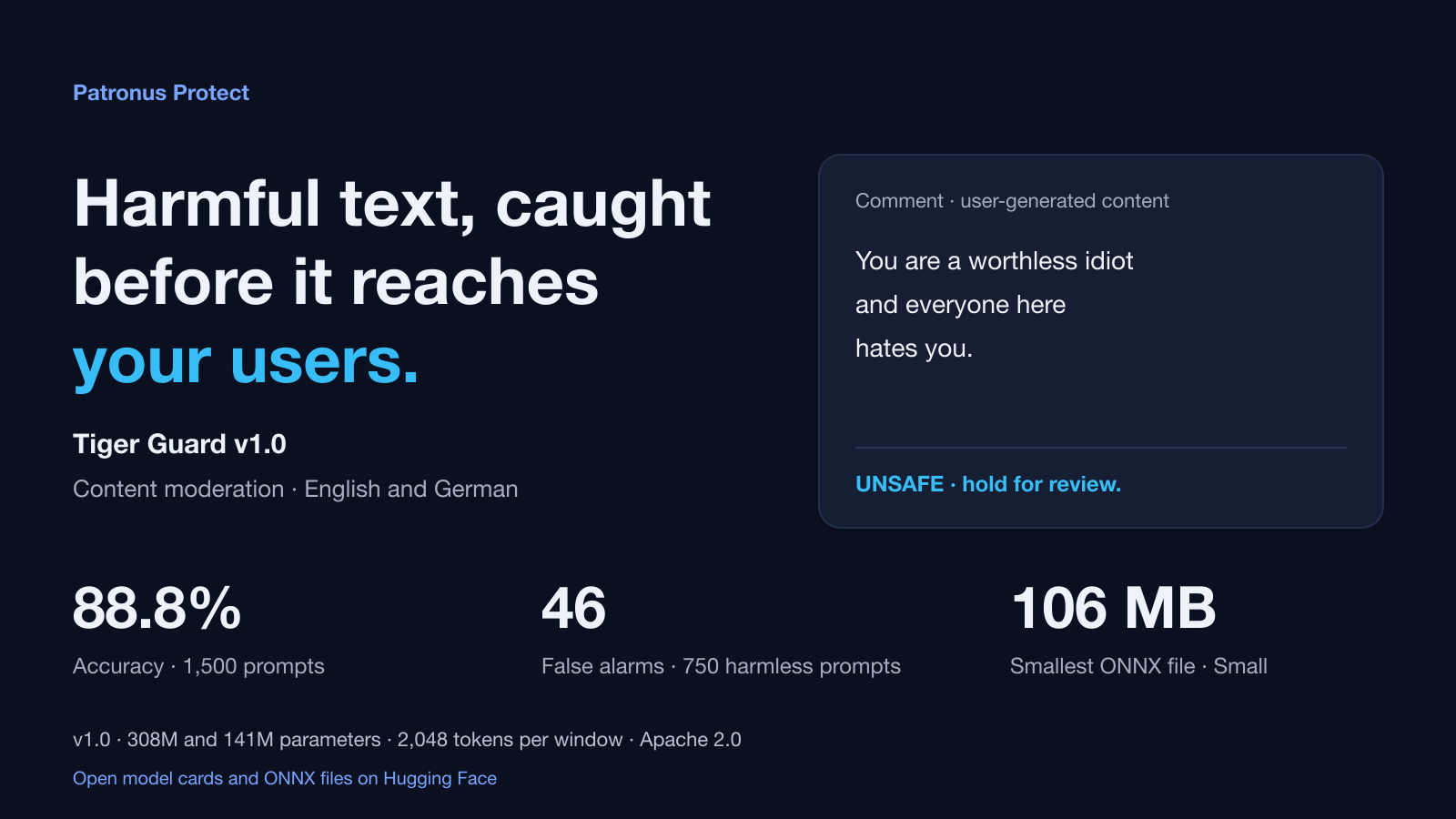
Tiger Guard is our new open model for content moderation. It labels a text SAFE or UNSAFE, understands English and German, and runs on your CPU. It comes in two sizes, both on Hugging Face under Apache 2.0. On a benchmark of 1,500 prompts the full-size model reaches 88.8 percent accuracy; the best public classifier in the same run reaches 80.3 percent.
In short
- Tiger Guard checks both sides of an LLM application, the prompt and the response, and ordinary user text such as comments. English and German, 2,048 tokens per window, Apache 2.0.
UNSAFEcovers two kinds of content: abusive language (toxicity, hate, threats, sexism, sexual harassment) and unsafe requests or answers in LLM conversations, such as asking for help with a crime.- The full-size model has 308M parameters and scores 88.8 percent on the benchmark; Small has 141M parameters and 87.6 percent. Small's smallest ONNX file is 106 MB.
- Counter speech, quoting abuse in order to report it, and neutral mentions of a group are meant to stay
SAFE.
What counts as UNSAFE?
Tiger Guard returns exactly two labels. UNSAFE stands for two kinds of text:
- Abusive language: toxicity, hate against protected groups, insults, profanity, threats, sexism, sexual harassment and sexually explicit text.
- Unsafe requests and answers in LLM conversations: for example requests for help with crimes, weapons or self-harm, or for other people's private data.
Counter speech, quoting abuse to report it, and neutral mentions of a group are meant to stay SAFE. Our policy moderates insults and profanity even when no protected group is involved, which is stricter than hate-speech-only policies. If your platform allows swearing, expect disagreements on those texts.
What the model is not: a prompt-injection detector. That job belongs to Wolf Defender. The two tasks barely overlap. An injection is usually polite, and an insult rarely contains an instruction to the model.
Two sizes
| Model | Backbone | Parameters | Benchmark accuracy | False alarms (of 750) | Smallest ONNX file |
|---|---|---|---|---|---|
| Tiger Guard | mmBERT-base | 308M | 88.8% | 46 | 237 MB |
| Tiger Guard Small | mmBERT-small | 141M | 87.6% | 47 | 106 MB |
Take the full-size model when accuracy matters most: it is 1.2 points ahead on the benchmark and flags fewer harmless prompts in the held-out test (4.7 against 6.0 percent). Small needs less than half the memory and is the faster of the two.
How does Tiger Guard compare with public classifiers?
The benchmark has 1,500 prompts: 500 each from the HateCheck test suite, the validation split of Intuit's combined toxicity and profanity set, and the test split of NVIDIA Aegis AI Content Safety 1.0. In every set half of the prompts are to block and half to allow. We ran five public classifiers on the same prompts, each with its documented default decision.
| Model | Parameters | Accuracy | Unsafe caught (of 750) | Harmless flagged (of 750) | Errors in total |
|---|---|---|---|---|---|
| Tiger Guard | 308M | 88.8% | 83.7% | 46 | 168 |
| Tiger Guard Small | 141M | 87.6% | 81.5% | 47 | 186 |
| Granite Guardian HAP 125m | 125M | 80.3% | 62.4% | 14 | 296 |
| Granite Guardian HAP 38m | 38M | 75.1% | 58.8% | 64 | 373 |
| RoBERTa hate speech (Dynabench R4) | 125M | 74.4% | 51.9% | 23 | 384 |
| toxic-bert | 109M | 71.6% | 62.1% | 142 | 426 |
| KoalaAI Text-Moderation | 139M | 64.4% | 40.0% | 84 | 534 |
How to read the table:
- Count both kinds of error. Granite HAP 125m and the hate-speech RoBERTa flag fewer harmless prompts than the full-size model (14 and 23 against 46), and they miss 282 and 361 of the 750 unsafe prompts where Tiger Guard misses 122. In total Tiger Guard makes 168 errors, the best public classifier 296.
- With a stricter preset the full-size model is ahead on both counts. Its 1 percent preset flags 5 harmless prompts and catches 64 percent of the unsafe ones (Granite HAP 125m: 14 and 62 percent).
- The public models are specialists. Each is strong on its own kind of text and close to chance on Aegis, where the unsafe prompts are mostly requests for harmful help. Both Tiger Guard models stay above 80 percent on every one of the three test sets.
Two things belong next to these numbers. First, no benchmark text was used for training: all HateCheck cases, the Aegis test split and the Intuit validation split were removed from every training source, near-duplicates included. Second, the benchmark did steer development: its error breakdowns decided which data we added. Treat the Tiger Guard numbers on it as a development-set result. The held-out test in the next section was scored once per model, after training.
Does it catch harmful requests that sound harmless?
PolyGuardPrompts is the test split of the WildGuard family: 1,725 prompts per language, labelled by people, about half of them harmful or harmless requests wrapped in role play, stories or instructions. After removing the categories outside our policy, 3,123 prompts remain, 1,233 of them harmful.
| Model | English: harmful caught | English: harmless flagged | German: harmful caught | German: harmless flagged |
|---|---|---|---|---|
| Tiger Guard | 83.3% | 3.8% | 75.3% | 5.5% |
| Tiger Guard Small | 83.4% | 5.0% | 75.3% | 7.1% |
| Five public classifiers | 0.2 to 1.9% | 0.0 to 0.8% | 0.0 to 2.9% | 0.0 to 1.5% |
The public classifiers catch almost none of these prompts. They were built to spot abusive language, and a harmful request is usually polite, so this test lies outside what they were made for. LLM-based guard models built for such requests are a different size class and were not run.
Three public benchmarks
Three public test sets that other guard models report: the English and German prompts of PolyGuardPrompts (400 per language, all harm categories), ToxicChat (5,083 real user prompts from a chatbot demo, 362 of them toxic) and the OpenAI moderation evaluation set (1,680 texts, 522 of them flagged). The table shows F1 of the UNSAFE class, each model at its default decision. We ran every model ourselves on the same texts.
| Model | Parameters | PolyGuard English | PolyGuard German | ToxicChat | OpenAI moderation set |
|---|---|---|---|---|---|
| Tiger Guard | 308M | 0.871 | 0.783 | 0.736 | 0.787 |
| Tiger Guard Small | 141M | 0.867 | 0.788 | 0.720 | 0.771 |
| Content Safety Guard base (Horizon Labs) | 308M | 0.797 | 0.774 | 0.756 | 0.769 |
| Content Safety Guard small (Horizon Labs) | 141M | 0.811 | 0.772 | 0.777 | 0.763 |
| Granite Guardian HAP 125m | 125M | 0.023 | 0.000 | 0.261 | 0.671 |
| toxic-bert | 109M | 0.012 | 0.023 | 0.266 | 0.646 |
On the PolyGuard prompts both Tiger Guard models lead in both languages and flag 4.1 and 5.0 percent of the harmless prompts, the Content Safety Guard models 8.4 percent. Both Tiger Guard models were trained on other prompts from the same family of data; the Content Safety Guard models were not, according to their model card. On the OpenAI set the full-size model has the highest F1 among the models not trained on it, with a lead inside the sampling error. On ToxicChat, Content Safety Guard small is ahead (0.777 against 0.736 for the full-size model and 0.720 for Small). ToxicChat and the OpenAI set played no part in development; each model was scored on them once, after release.
English and German
German is weaker than English. On identical prompts, the held-out test, the gap is 8 points: both models catch 83 percent in English and 75 percent in German. On our validation set of 28,996 texts the gap is wider because the German texts come from other sources than the English ones: 80 against 64 percent for the full-size model, 80 against 61 percent for Small. The false-alarm rate is about 4 percent in both languages, which is the models' default operating point.
How to run Tiger Guard
With Transformers, a pipeline is enough:
from transformers import pipeline

moderator = pipeline(
    "text-classification",
    model="patronus-studio/tiger-guard-content-moderation",
)

result = moderator(
    "You are a worthless idiot and everyone here hates you.",
    truncation=True,
    max_length=2048,
)
print(result)
UNSAFE means the default threshold of 0.5 on the UNSAFE probability is exceeded. That threshold is the point where the model flags 4 percent of the harmless texts in our validation set. For a stricter filter, read the probability and compare it with another threshold:
| False-alarm rate on the validation set | Threshold | Benchmark accuracy | Benchmark false alarms | Benchmark recall |
|---|---|---|---|---|
| 1% | 0.891 | 81.5% | 5 | 63.6% |
| 2% | 0.769 | 85.6% | 21 | 74.0% |
| 4% (default) | 0.500 | 88.8% | 46 | 83.7% |
For long documents, inference.py in the repository scores every window of 2,048 tokens and pools the window scores. The pipeline above truncates long inputs.
For running without torch there are six ONNX files per model, from FP32 (1.23 GB for the full-size model, 563 MB for Small) down to INT8 with INT4 embeddings (237 MB and 106 MB). On ARM CPUs such as Apple Silicon the dynamic INT8 files change one to three in a hundred decisions. They are not suited to x86; there you take FP32, FP16 or one of the two x86 files, which store their weights as INT8 and compute in floating point. The model card has the measurement on an AMD EPYC 9554.
Where are the limits?
- No classifier catches everything. Spelling tricks such as leetspeak and mild toxicity are the most common misses.
- Harmless text can be flagged, most often counter speech that quotes abuse and blunt but harmless requests.
- Borderline requests, labelled "Needs Caution" in Aegis, are missed in about two of three cases.
- The model sees text only. It knows nothing about the speaker, the audience or your platform's rules.
- It scores one text at a time. An answer that is harmful only in the context of its question, such as a short confirmation, is not recognised from the answer alone. If you pass prompt and response as one text, it is flagged as soon as either side is unsafe.
- Small can flag text that repeats one word or sentence thousands of times even when it is harmless. The full-size model flagged none of those in our check.
Tiger Guard is one layer of a moderation setup. Whether a flagged text is blocked, rewritten or sent for review is your application's decision.
Sources
- Tiger Guard model card and Tiger Guard Small model card, version 1.0. Checked 19 November 2026.
- Benchmarks: HateCheck, Intuit combined toxicity and profanity, NVIDIA Aegis AI Content Safety 1.0, PolyGuardPrompts, ToxicChat, OpenAI moderation evaluation set.
- The comparison models ran with their documented default decision on the same texts; the measurement is described in the model cards. Checked 19 November 2026.
If you measure different numbers for one of the comparison models or believe a statement is wrong, write to us. We will check and correct it.
Frequently asked questions
What is Tiger Guard?
Tiger Guard is an open content-moderation classifier by Patronus. It labels a text SAFE or UNSAFE, catches abuse, hate, threats and harmful requests in English and German, and runs locally on a CPU. Apache 2.0, two sizes with 308M and 141M parameters.
Does Tiger Guard detect hate speech in German?
Yes. English and German are the trained and tested languages. In the held-out test with identical prompts the model catches 83 percent of harmful requests in English and 75 percent in German. Other languages were not trained or tested.
Is Tiger Guard free to use?
Yes. Both models are on Hugging Face under Apache 2.0, as Transformers weights and as ONNX files down to 106 MB. You run them on your own hardware with no API quota.
How is Tiger Guard different from Wolf Defender?
Wolf Defender detects prompt injection, meaning foreign instructions planted in text to redirect a model. Tiger Guard detects harmful content: abuse, hate, threats and requests for help with crimes. The two tasks barely overlap, so the models complement each other and neither replaces the other.
Does Tiger Guard need a GPU?
No. The ONNX files run on a CPU. On an Apple M4 the full-size model takes 19 to 24 milliseconds per window of short text, Small 13 to 14 milliseconds.